
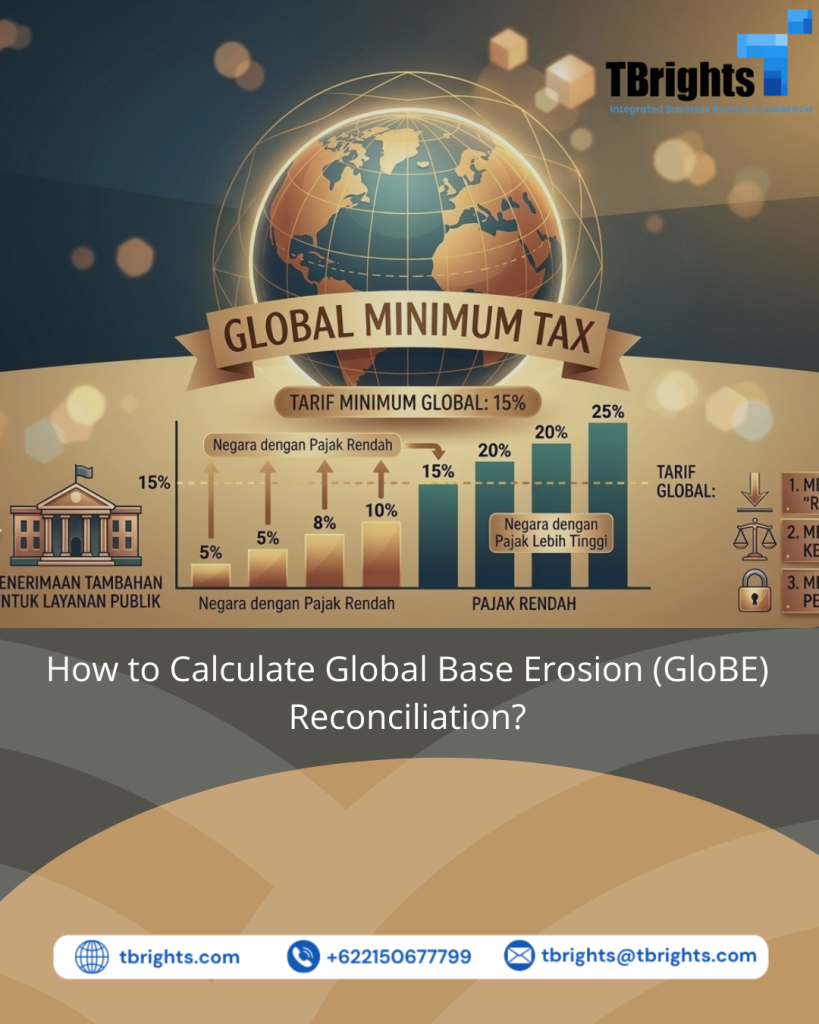
Global Base Erosion (GloBE) emerged due to the phenomenon of base erosion and profit shifting. Base erosion and profit shifting is the act of tax avoidance by transferring profits to countries with low or zero tax rates, carried out by multinational companies. Several steps are required to calculate GloBE. The calculation steps are as follows:
- Pre-calculation step: At this step, required to determine the Ultimate Parent Entity (UPE) or the company at the top of the multinational company’s ownership hierarchy. Must also ensure that the UPE has passed the consolidated income of Euro 750 million for 2 years out of a minimum of 4 tax years prior to the imposition of GMT. In addition, the Constituent Entity (CE) in each jurisdiction that is subject to GloBE tax must also be determined.
- First step: At this step, required to determine whether to use International Financial Reporting Standards (IFRS) or Generally Accepted Accounting Principles (GAAP) for the financial statements. Ensure that the currency of each CE jurisdiction is used.
- Second step: At this step, required to calculate the financial accounting net income (FANI) by using the profit/loss calculation before tax for each CE and removing the accounts that contain extraordinary and non-recurring journal amounts.
- Three step: At this step, multinational companies are required to adjust FANI to GloBE income by making several corrections to income, expenses, and timing.
- Fourth step: At this step, multinational companies combine GloBE income per country by adding up the GloBE income for each country.
- Fifth step: In this step, the covered tax is determined, which consists of current tax and deferred tax according to GloBE. Current tax includes corporate income tax, withholding tax borne by the company, and local tax, while deferred tax according to GloBE is recalculated by multiplying the temporary difference by the maximum GloBE rate of 15%.
- Sixth step: At this step, multinational companies calculate the effective tax rate (ETR) per country. The ETR percentage is calculated by dividing covered taxes by GloBE income. Next, compare the %ETR result with the minimum rate of 15%.
- Seven step: At this step, top-up tax is imposed if the ETR result is less than 15%, so that the top-up tax percentage is calculated as 15% – %ETR. Before multiplying by the top-up tax percentage, GloBE income is first reduced by the substance-based income exclusion (SBIE).
- Eighth step: At this step, multinational companies determine the amount of SBIE by (SBIE = (α x payroll) + (β x Tangible Assets), where α and β are constants that have been set based on the GloBE rule between 10% and 15%. Payroll expenses consist of wages, salaries, bonuses, social security contributions, and pension contributions, while tangible assets consist of property, plant & equipment, land & buildings, and machinery.
- Nine step: At this step, multinational companies allocate top-up tax in the following order: QDMTT (Source Country), then IIR (Parent Group), and finally UTPR (any country where CE operates).
The GloBE calculation steps are created to make it easier for multinational companies that have fulfilled the criteria for global minimum tax imposition to carry out their tax obligations in line with international tax developments, so that the level of tax compliance of multinational companies can increase internationally.
By Olina Rizki Arizal
TBrights is a tax consultant in Indonesia that is currently an Integrated Business Service in Indonesia that can provide comprehensive tax and business services.
Referance:
- The Minister of Finance Regulation No. 136 of 2024 concerning the Imposition of a Global Minimum Tax Based on International Agreements
