
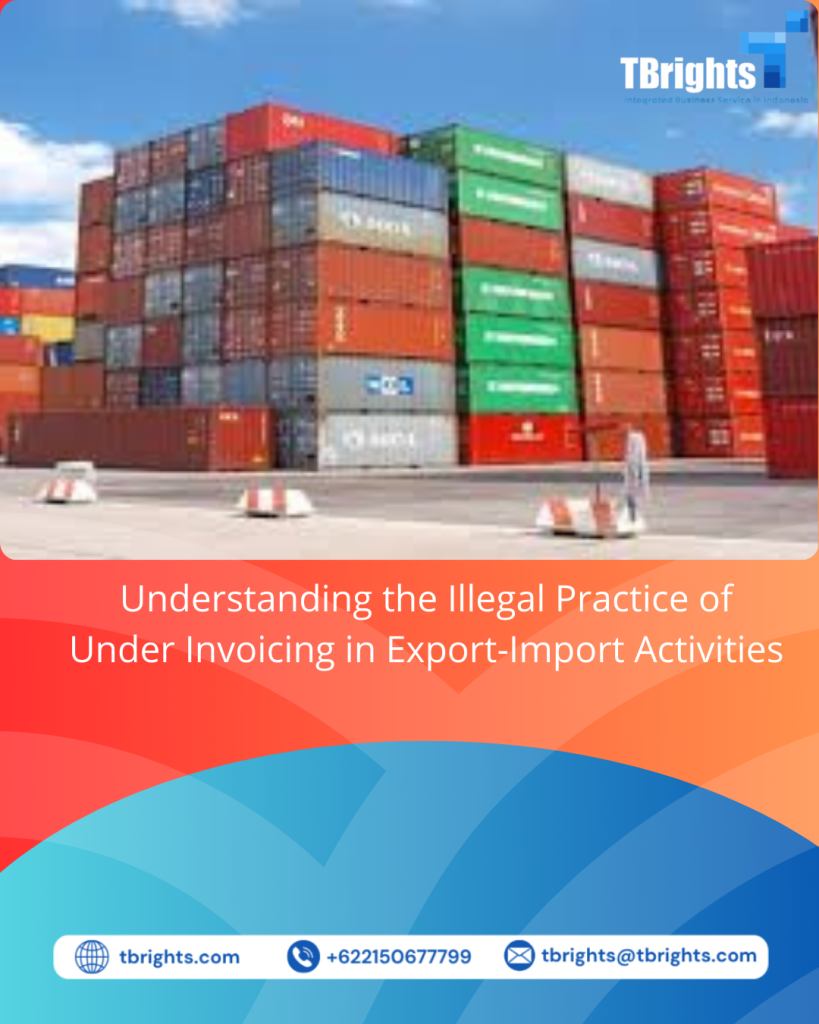
Recently, the Ministry of Finance through the Directorate General of Taxes issued a warning to businesses in the palm oil sector due to findings of under invoicing and the use of fictitious invoices. In addition, the Ministry of Finance plans to freeze the Directorate General of Customs and Excise due to the rampant practice of under invoicing and the weak prevention of illegal goods at the country’s borders. Under invoicing is the practice of listing a value or nominal amount that is lower than the actual price of goods or services. This practice is essentially aimed at reducing the amount of tax payable and obtaining benefits in the form of import duty and tax exemptions.
The practice of under invoicing is generally carried out by manipulating documents by entering a lower price on the invoice than the transaction price in the hope that export taxes will be lower and benefit palm oil companies. This practice is certainly illegal because it can harm state revenue from the customs sector. Due to the prevalence of under invoicing, the government, through the Ministry of Finance, issued Minister of Finance Regulation No. 96 of 2023 concerning Customs, Excise, and Tax Provisions on the Import and Export of Consignments to follow up on the practice of under invoicing.
In the Minister of Finance Regulation number 96 of 2023, the government strengthens supervision, requires partnerships between marketplaces and the Directorate General of Customs and Excise for the exchange of e-invoice data, and implements self-assessment and fines for violators. To improve the supervision of shipped goods, the Directorate General of Customs and Excise implements an application modified with artificial intelligence. It is hoped that the use of artificial intelligence will detect invoices or documents that are not in accordance with under invoicing.
Under invoicing is an illegal practice that can harm state revenues. The state strives to find sources of revenue to build the community’s economy. The existence of under invoicing causes state revenues to decline. The state’s efforts to build the economy should be well supported by the community, both entrepreneurs and non-entrepreneurs. Therefore, there needs to be synergy between the state and entrepreneurs. As entrepreneurs, they are required to comply with existing regulations. The government, as the regulator, is expected to be fair to entrepreneurs engaged in the import-export sector so that the regulations it creates do not harm entrepreneurs. It is hoped that the practice of under invoicing can be minimized or even eliminated in the future so that state revenue can increase.
By Olina Rizki Arizal – Partner
TBrights is a tax consultant in Indonesia that is currently an Integrated Business Service in Indonesia that can provide comprehensive tax and business services
Referance:
- The Minister of Finance Regulation Number 96 of 2023 on Customs, Excise, and Tax Regulations on the Import and Export of Consignments
